Higher recycled content. Higher efficiency. Lower carbon footprint.
Innovation in extrusion does not happen in isolation. It is the result of collaboration, technical expertise, and measurable validation under real production conditions.
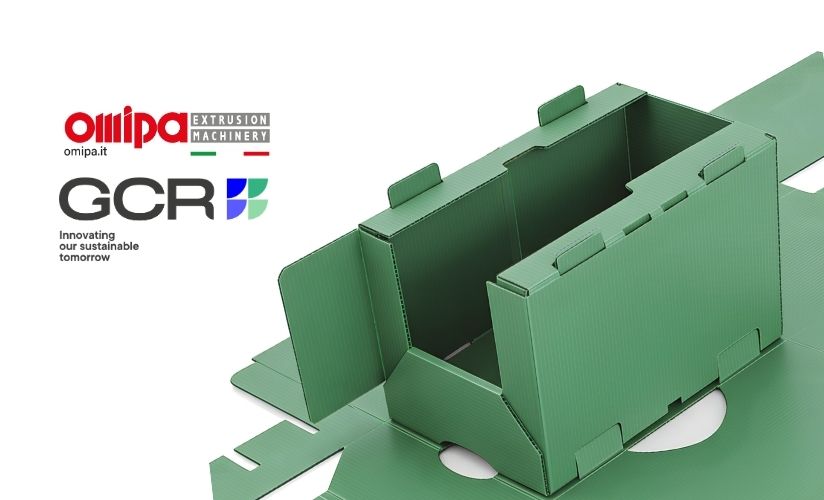
Omipa and GCR have successfully validated a new formulation for X-type hollow sheets, designed for demanding applications in industrial packaging and building & construction.
The result?
A lightweight, shock-resistant hollow sheet with 47% lower CO₂ footprint, without compromising mechanical performance.
The Challenge: Recycled Content Without Compromise
In applications such as formwork panels, protection boards and collapsible pallet boxes, hollow sheets must withstand heavy loads and impact stress.
Traditionally, converters rely on PP copolymer and closed-loop recycled material to maintain impact resistance and structural integrity.
The challenge was clear:
Could recycled PP homopolymer reach high recycled content levels while maintaining mechanical performance and process efficiency on OMIPA extrusion lines?
Since homopolymer provides stiffness but lower impact resistance compared to copolymer, balancing mechanical properties and processability required a carefully engineered formulation.
The Solution: Formulation Meets Extrusion Expertise
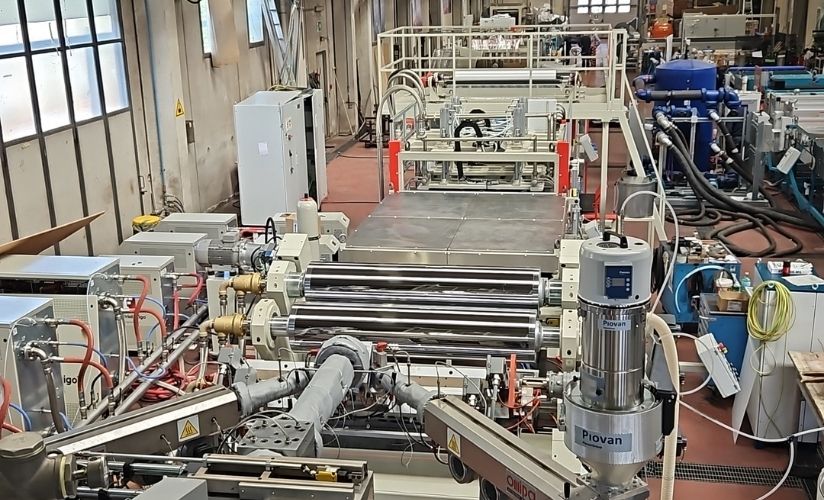
The validation was performed on Omipa’s X-wall hollow sheet extrusion lines, combining:
- Ciclic® – recycled PP homopolymer for high recycled content
- Granic® – mineral masterbatch enhancing: impact resistance, flexibility, dimensional stability and processability
This formulation-driven approach transformed material selection into a competitive advantage.
The Measurable Results
Under real production conditions, the collaboration delivered clear and quantifiable improvements:
47% lower CO₂ footprint
20% higher line speed
14% increase in torque efficiency
6% material savings
100% recyclable sheet
Compression and impact strength fully aligned with specifications
Long lifespan with lightweight structure
The combination of optimized formulation and extrusion process control enabled higher output, lower energy demand, and uncompromised strength.
A Partnership Built on Engineering Value
This success case demonstrates how formulation expertise and extrusion technology can work together to achieve sustainability targets without sacrificing industrial performance.
For Omipa, it confirms a core principle: responsible thinking starts from process design and extends to measurable production efficiency.